Last Thursday morning, I took one of my sons to occupational therapy.
Then I went back to the car to wait.
Except waiting time is not really waiting time anymore. It is when I do the unpaid administrative work assigned to me by the state of Illinois, Medicaid, and every system that says help exists but still needs a mother to chase it down.
I sat in the parking lot with my phone pressed to my ear, trying to move paperwork forward for a safety bed for my younger son.
That occupational therapy appointment was the fourth therapy appointment in our household that week.
It was only Thursday morning.
This is not the part of caregiving people usually picture.
They picture tenderness. Patience. A mother showing up again and again because she loves her children.
And I do love my children.
But love is not the whole story.

Love is what makes me keep going. It is not what makes the work disappear.
That is the trick.
If the system can call this love, it does not have to count it as labor.
Caregiving in my house means watching for safety risks before they become emergencies. It means remembering which child has therapy, which one needs paperwork, which accommodation still needs approval, which agency handles which support, and which voicemail I have already left.
It means occupational therapy, speech waitlists, mental health appointments, Medicaid calls, housing requests, safety equipment, medication questions, sensory needs, behavior tracking, transportation, and a calendar that looks less like family life and more like case management.
Except there is no case manager doing all of it.
There is me.
A disabled mother raising disabled and neurodivergent children while functioning as the intake department, scheduling department, transportation department, records department, and follow-up department for my own family.
People call mothers like me strong.
I know they usually mean it kindly.
But sometimes strong is the word people use when they do not know how to name unsupported labor.
Strong is not what I feel sitting in a parking lot on hold between therapy appointments.
I feel tired. I feel behind. I feel like my brain has too many tabs open and every one of them matters.
I am not strong in some inspirational way.
I am determined.
There is a difference.
Determination is what happens when quitting is not an option, but neither is collapsing. It is what keeps me calling because I still believe we can build a life that works for our family.
I want my children supported. I want them safe. I want therapy, equipment, and accommodations to become real tools in their lives, not words I keep repeating into voicemail.
That explains why I keep doing the work.
It does not make the labor less real.
Caring for my children is my responsibility.
Replacing a care system is not.
Family caregiving is often described in the language of love while being used as unpaid infrastructure.
A mother keeps the child safe, so the safety gap looks smaller than it is.
A mother rearranges her schedule, so the service gap looks manageable.
A mother makes calls from the parking lot, so the coordination gap disappears from view.
A mother gives up work hours, sleep, privacy, and pieces of her own future, so the system can keep functioning as though care simply happens at home.
But care does not simply happen.
Someone does it.
Someone remembers. Someone watches. Someone calls. Someone follows up. Someone absorbs the crisis before it becomes visible enough for anyone else to count.
In my house, that someone is usually me.
I know I am not the only one.
Across the country, families are holding together care systems with calendars, pill bottles, therapy bags, Medicaid cards, appointment reminders, and the kind of exhaustion that does not photograph well.
We do not always look like a crisis.
Sometimes we look organized.
Sometimes we sound calm on the phone because we have learned that sounding too overwhelmed can get us dismissed, while sounding too capable can make people think we do not need help.
So we aim for the middle.
Urgent, but polite.
Exhausted, but competent.
Desperate, but not too desperate.
We become fluent in the performance of manageability.
That is labor too.
Some parts of caregiving are easy to recognize: driving, feeding, bathing, redirecting, supervising, and staying awake.
Other parts are softened into sentiment: soothing, encouraging, anticipating, absorbing, and loving through it.
But the administrative labor is harder to see.
The forms. The referrals. The eligibility rules. The documentation. The portals. The waitlists. The follow-up calls. The agencies that each handle one narrow piece of a life that does not divide itself neatly into service categories.
This work is not extra.
It is the gate.
Before a child receives support, someone has to prove the need, find the door, learn the language, gather the paperwork, and keep asking until the request lands on the right desk.
Most of the time, that someone is a parent.
Often, it is a mother who is already providing the care that proves the need exists.
The work is being paid for.
It is being paid for in mothers’ bodies, lost income, lost sleep, and futures postponed.
The system sees a child being cared for.
It does not see the parent disappearing into the care.
It sees the therapy appointment. It does not see the drive, the forms, the calls, the home practice, the meltdown afterward, or the dinner that still needs to be made.
It sees a child safe in bed. It does not see the mother who could not sleep until the equipment was approved.
It sees a family managing.
It does not see what managing costs.
It does not see the work hours that never happen because there are too many appointments. It does not see the writing time I lose because the quiet hour became a phone-call hour. It does not see the projects I am trying to build in the margins of a life that keeps filling every margin with someone else’s urgent need.
It does not see how impossible a traditional job would be inside this level of caregiving.
I cannot work a normal schedule and provide this amount of care to my children.
Not because I do not want to work.
Not because I lack ambition.
Not because I am lazy or unmotivated.
I cannot do both because there are only so many hours in a day, and my body is not an endless resource.
I am disabled too.
I live with chronic illness, chronic pain, migraines, mobility limits, and a body that does not always cooperate with what my life requires.
But the appointment schedule does not care if I am flaring. The paperwork does not care if I have a migraine. The safety concerns do not care if I slept badly because a child slept badly.
The phone calls do not care that I am making them from a body that needed rest three hours ago.
I am fighting my own body to fight the system for my children.
Then people call me strong.
Sometimes strong is the word people use when they do not want to say unsupported.
Sometimes it is the word they use when they do not want to say overworked.
Sometimes it is the word they use when they do not want to say unpaid.
It turns survival into personality.
It turns endurance into virtue.
It makes the load sound noble instead of heavy.
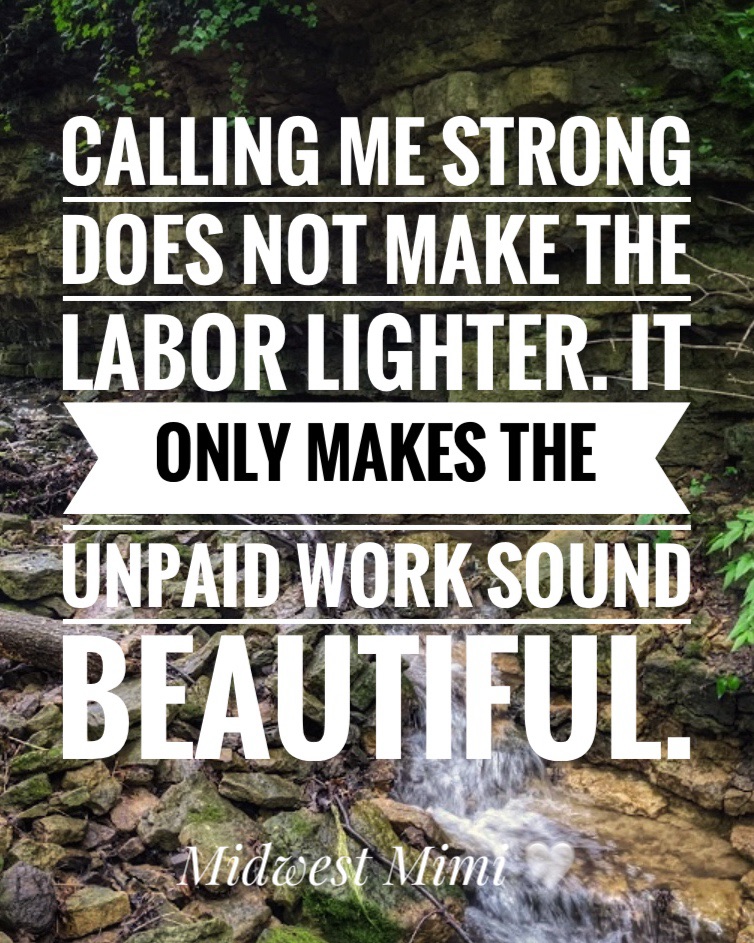
Calling me strong does not make the labor lighter.
It only makes the unpaid work sound beautiful.
I do not want my family’s care to depend on whether I can be beautiful about exhaustion.
I do not want my children’s support to depend on whether I can keep sounding competent while overwhelmed.
I do not want a system that quietly counts on mothers to absorb every gap and then praises us for not falling apart sooner.
I know the person answering the phone may be overworked too. I know therapists have waitlists. I know agencies have rules. I know Medicaid programs have limits.
I am not angry because one person failed me.
I am angry because the design keeps handing the work back to families and calling that access.
I want my children in our home, in our community, and in ordinary life, with support that actually supports them.
I want therapies to help. I want equipment to arrive before crisis. I want accommodations understood before a family has to plead for them. I want care coordination that coordinates care.
I want someone to recognize that the parent providing the care should not also have to become an unpaid case manager by default.
But that is what this becomes.
The system depends on unpaid caregiving while pretending it is private family devotion.
It depends on love.
It depends on mothers rearranging their lives.
It depends on parents remembering, calling, driving, documenting, supervising, researching, advocating, and trying again tomorrow.
Then, when we are exhausted, it calls us strong.
I am not asking anyone to love my children as much as I do. I know they will not.
I am asking them to stop building systems that only work because mothers disappear inside them.
Love can do a lot.
Love can keep calling. Love can sit in parking lots. Love can learn acronyms. Love can rearrange a house around safety. Love can show up to the fourth therapy appointment of the week and still ask what else needs to be done.
But love is not infrastructure.
It is not respite.
It is not a substitute for systems that work.
By the time my son came back out from therapy, I had not rested. I had not worked. I had not had a quiet hour to myself.
I had moved one more piece of the system forward from the front seat of my car.
Then I put the phone down, opened the door, and went back to mothering.
I will keep loving my children.
That has never been the question.
The question is why that love is allowed to hide so much labor.
Family caregiving is love.
But it is also labor.
Pretending otherwise does not make the work disappear.
It only makes the worker disappear.


Leave a comment