Content note: child abuse/child sexual assault
If danger is immediate, call 911. For nationwide help, call or text Childhelp at 1-800-4-A-CHILD (1-800-422-4453).
If Your Child Tells You Something Hard, Your First Words Matter
When your child tells you they have been harmed, it breaks your heart. I’ve learned the hard way that the most difficult parenting moments don’t come with a script.
This guide gives you exact words to say, what not to do, and what happens next.
When my own child disclosed to me I was shocked, angry, and scared. Part of me wanted to cry, part of me wanted to rage, and part of me wanted to wrap my child in my arms and never let go. But most of all, I didn’t know what to say or how to support without causing further harm.
I froze as emotions rushed through me. In the back of my mind, a voice whispered: how did you let this happen?
But in that moment, your feelings aren’t what matter. What matters is your child. Focus on them, and make sure they feel safe and supported.
👉 You don’t have to do everything today—just the next right thing.
Table of Contents
Signs of Abuse: What to Watch For
Exactly What to Say in the First Minute
How to Report and Protect Your Child
When Abuse Happens at School or Daycare
Supporting Siblings and Family
Caring for Yourself While Supporting Your Child
Signs of Abuse: What to Watch For (Pre-Disclosure)
Not every child will come forward right away. Some never say the words directly. Parents often wonder, “How do I know if something might be wrong?”
Possible warning signs include:
Sudden changes in behavior or mood (withdrawal, aggression, fearfulness).
Regression (bedwetting, clinginess, loss of skills).
Avoidance of certain people, places, or activities.
Unexplained injuries or frequent vague complaints of pain.
Sexualized knowledge or behavior beyond what is developmentally expected.
No single sign proves abuse. But if you notice concerning patterns, trust your instincts, ask gentle questions, and seek professional guidance. Early action can make a difference.
Exactly What to Say in the First Minute
When a child discloses abuse, your words matter more than anything. They need to hear that you believe them and that they’re not alone. A few simple sentences are enough:
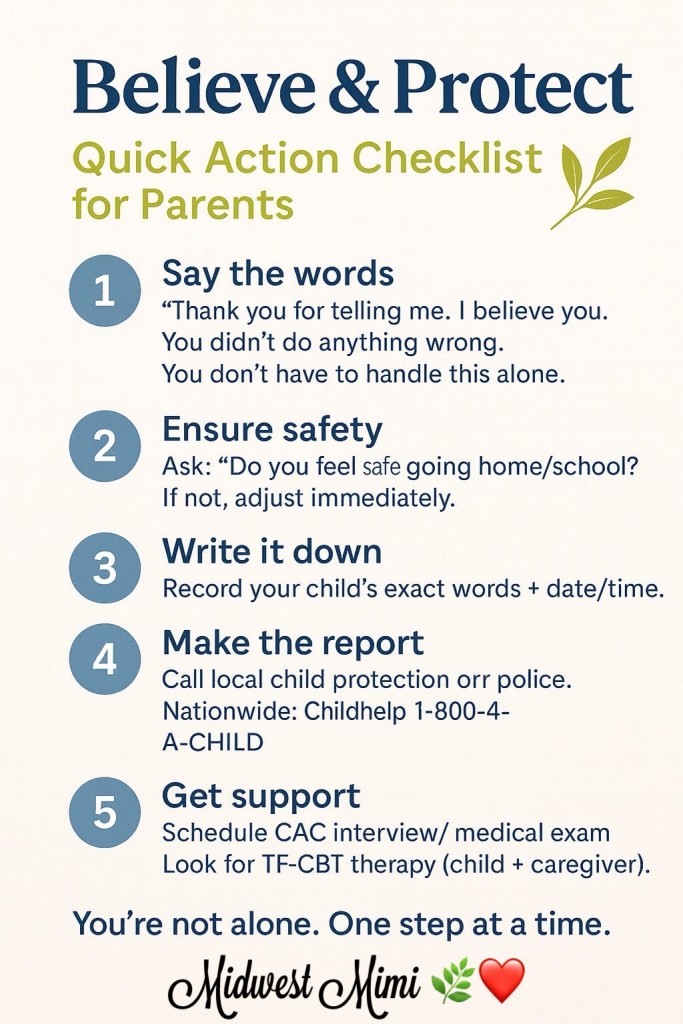
“Thank you for trusting me enough to tell me.”
“I believe you.”
“You didn’t do anything to deserve this.”
“You don’t have to handle this alone.”
You don’t have to have all the answers. Just steady your voice, keep your focus on them, and let these words carry the moment.
What Not to Do
In moments of shock, it’s easy to respond in ways that unintentionally make things harder for your child. Here are some things to avoid:
Don’t promise secrecy. Be honest: you’ll share only with people who can keep them safe. It’s their story to tell when they’re ready.
Don’t press for details or ask leading questions. Let them share what they choose. Document, don’t interrogate: write their exact words with date/time. Leave follow-ups to trained forensic interviewers.
Don’t confront the alleged abuser. It can jeopardize the case and increase risk for you and your child.
Don’t ask, “Why did it take you so long to tell me?” Kids already carry fear and shame. They don’t need more guilt. As a survivor myself, I know how abusers use threats, lies, and secrecy to keep children silent.
Documentation & Privacy
In the first hours and days, what you write down and what you don’t share matter.
Record your child’s exact words with date and time. Keep a simple log of who you notified (school, DCFS, law enforcement). Store notes in a private place — not in a group chat or on social media. Screenshots and posts can circulate quickly and complicate the case.
Keeping documentation clear and private helps professionals do their job and protects your child’s story.
Quick Safety Check (60 Seconds)
Ask your child:
“Do you feel safe going home?”
“Do you feel safe going back to school or daycare?”
If “no,” consider time away. Illinois allows up to five mental-health days for students; check your district’s policy and arrange trauma-informed counseling.
How to Report and Protect Your Child
Once your child discloses, the next step is to contact your local child protection agency or law enforcement. Even if you’re unsure, it’s better to report and let professionals investigate.
In Illinois: Call the DCFS hotline at 1-800-25-ABUSE or use the online reporting system for non-emergencies.
In other states: Each state has its own child protection agency and reporting hotline.
You can: Call your local police or sheriff’s department. Search “[your state] child abuse hotline” online — most states publish the number on their government or child welfare site.
Call the Childhelp National Child Abuse Hotline at 1-800-4-A-CHILD (1-800-422-4453) — counselors are available 24/7 to connect you with the right local agency.
Teachers, doctors, and other professionals are mandated reporters, but anyone can and should make a report if they suspect abuse.
What to Expect After a Report
Many parents fear the unknown once a report is made. Here’s what may happen next:
Contact from child protection services or law enforcement. They may visit your home or ask you to bring your child to a Child Advocacy Center.
Separate conversations. Investigators often talk to parents and children separately to get clear, unbiased information. Paperwork and timelines.
You may be asked for documentation or statements. Each state’s process is slightly different, but professionals will guide you step by step.
Remember: a report starts a process designed to protect children, not punish safe caregivers.
Forensic Interviews: What They Are and Why They Matter
After a report, your child may have a forensic interview at a Child Advocacy Center—a recorded, age-appropriate conversation with a trained professional that prevents repeated questioning and preserves accuracy.
You may not be in the room, but reassure your child: the interviewer’s job is to listen, believe, and protect them.
Medical Care at a Child Advocacy Center
Your child may also have a trauma-informed medical exam at a CAC to check for injuries, infections, and—when appropriate—pregnancy. Just as important, the exam shows your child their body is being cared for as much as their emotions.
Timeline: In some cases, evidence can be collected within 72–120 hours, depending on age and puberty.
Low cost or no cost: Exams and related services are often free or very low cost through CACs (policies vary by state).
Non-acute care: Even if the evidence window has passed, an exam is still valuable for health, reassurance, and connection to resources.
When Abuse Happens at School, Daycare, or With Another Child
If the abuse took place at school, daycare, or in a peer situation, notify the organization and request a written safety plan. Then let authorities manage the investigation.
Avoid labeling other minors or trying to resolve it yourself. Trained professionals are best equipped to handle these sensitive cases.
Email script (copy and paste):
Subject: Urgent: Safety Plan Request for [Child’s Name]
Dear [Principal/Director/Program Coordinator],
I am writing to notify you that my child, [Child’s Name], disclosed abuse involving [name/role, if known]. We have reported this to [agency name: DCFS, law enforcement, etc.].
For my child’s safety, I am requesting a written safety plan that includes:
Immediate steps to prevent contact between my child and [alleged person’s name/role].
Adjustments to supervision, classroom placement, or schedule as needed.
A designated staff member I can communicate with directly about safety concerns.
Please confirm the plan in writing as soon as possible.
Sincerely,
[Your Name]
[Your Contact Information]
Legal Protections
In some cases, law enforcement or child protection agencies can help you seek a no-contact order or protective order to prevent contact between your child and the alleged offender. Ask the professionals handling your case what options are available in your state.
If Your Child Recants
Sometimes children take back what they’ve said. Often they don’t realize what disclosure sets in motion, and when things get complicated they want to undo it. That usually signals fear, pressure, or confusion — not that it didn’t happen.
For teens, the backlash at school can be brutal: bullying, lost friendships, rumors, and constant whispers. Kids who disclose are already vulnerable; adding these layers can feel overwhelming.
Your role is to stay steady. Keep believing, keep protecting, and keep supports in place while professionals continue their work. If they waver, lean on your adult supports so they don’t have to carry your feelings.
Supporting Siblings and Family
Disclosure affects the whole family. Siblings may feel confused, scared, or left out.
Explain simply and age-appropriately. For young kids: “Something happened that wasn’t safe, and the adults are helping.” For teens: be more direct, but keep details private. Maintain routines. Familiar schedules help siblings feel secure. Make space for feelings. Each child may react differently — some may withdraw, others may act out. Offer reassurance and extra attention.
Keeping the home steady helps all children feel safe while the family navigates next steps.
The Best Therapy for Kids After Abuse (TF-CBT Explained)
Healing takes time. The therapy with the strongest evidence is Trauma-Focused Cognitive Behavioral Therapy (TF-CBT). It helps children reduce trauma symptoms while teaching caregivers how to support recovery.
The best part: both child and caregiver receive support. This shared approach strengthens the child’s healing process and gives parents tools they can use at home.
Look for providers trained in TF-CBT through CACs or child trauma networks in your state.
Caring for Yourself While Supporting Your Child
This is heavy. I’ve felt the swirl of anger, grief, and guilt myself. But your child needs you steady.
It’s important to process your feelings separately from your child. They are already overwhelmed and can’t carry your emotions on top of theirs. Talk to a partner or trusted friend. Seek therapy if you can. Processing your own anger and grief is critical — it’s how you’ll be able to show up for your child.
It’s okay if they see a few tears—emotions aren’t wrong. Just don’t hand them your anger or guilt.
Finding safe places to release your emotions is essential. Caring for yourself isn’t extra; it’s part of caring for your child.
Long-Term Healing
Disclosure is not the end of your child’s story — it’s the beginning of healing. With safety, therapy, and steady support, children can recover, thrive, and rebuild trust. Many survivors grow into strong, resilient adults who carry their story without being defined by it.
I know this personally. I am a survivor of childhood sexual abuse, and today I use my story to support and encourage others. Healing is possible.
Your presence, belief, and protection are the foundation of that healing.
Tonight / This Week
Tonight: Say the script. Ensure immediate safety. Write down your child’s words. Make the report.
This week: Go to the CAC for interview and medical exam. Notify school or daycare and ask for a safety plan. Contact a TF-CBT provider.
Small steps, one at a time, move you and your child forward.
You’re not alone. You can do this—one minute at a time.
Resources for Parents
Childhelp National Child Abuse Hotline: 1-800-4-A-CHILD (24/7 call or text)
RAINN Sexual Assault Hotline: 1-800-656-HOPE
Darkness to Light: Prevention and parent guides
National Children’s Alliance CAC Finder:
Frequently Asked Questions
What should I say if my child discloses abuse by text or in a note?
Respond with the same script: “Thank you for trusting me. I believe you. You didn’t do anything wrong. You don’t have to handle this alone.” Save the message or note exactly as it is and share it with professionals.
Should I ask my child for details about what happened?
No. Let your child share only what they want. Write down their exact words with date and time, but don’t ask follow-up questions. Trained forensic interviewers are skilled at gathering details safely.
What happens at a Child Advocacy Center (CAC)?
At a CAC, children may have a forensic interview and medical exam. Both are done by professionals trained to support kids in a safe, developmentally appropriate, and trauma-informed way. These services are often free or low cost.
What if my child takes back what they said?
Recanting is common and usually comes from fear, pressure, or confusion — not because the abuse didn’t happen. Keep supporting your child, report as required, and let professionals continue their work.
How do I find a therapist trained in TF-CBT?
Ask your local CAC for referrals, or search through state child trauma networks. You can also check the National Child Traumatic Stress Network (NCTSN) for providers.
Printable Guide: “Believe & Protect — A 60-Second Parent Response”
Download and save a one-page guide with:
First-minute script.
Quick safety check.
Hotline numbers.
CAC finder link.
This is the piece to keep handy — and to share with other parents who may one day need it.
Disclaimer: This guide is for support and information. It isn’t legal or medical advice. Local protocols vary. Always follow the guidance of professionals in your area.
 Midwest Mimi
Leave a comment