I was 19 years old when I told my mother what my step-grandfather, George, had done to me.
We were sitting side by side in the front seat of the car on our way to Sunday evening church. We started talking before we got there, and when we pulled into the parking lot, we were not finished. So we stayed in the car while the service went on inside.
I had carried that secret for years.
George had used fear and shame to keep me quiet. He exploited the fact that I loved my family, especially my brother, and used that love as leverage. I knew something about what he was doing was wrong, even when I was too young to fully understand it. I was afraid no one would believe me.
By 19, I knew intellectually that what happened was abuse and that I had not caused it. But knowing something intellectually is not always the same thing as feeling it.
I was not telling my mother because I had suddenly decided I was ready to process everything that had happened to me. I was telling because I wanted to give my cousin a way out.
My mother believed me. I do not remember the exact words she used. I remember that she was sad. I remember that she cried with me. I remember that she did not look at me differently. And I remember that once she understood what had happened, she wanted to help protect my cousin too.
There was something incredibly powerful in that. The terrible secret I had carried for years was suddenly outside of me, sitting there between my mother and me in that car, and the world did not end.
My mother still loved me. She did not think I was dirty. She did not think I had done something wrong.
She believed me.
For the first time, I began to understand that what happened to me was not something so shameful that I had to hide it forever.
George did not deserve my silence.
That first conversation did not immediately turn me into someone who could tell the whole world what happened. It started with one safe person.
Later, I began talking about it with women and girls who were part of my life and had stories of their own. I wanted them to know they were not alone. I wanted them to hear from someone who had lived through something similar and had made it to the other side of it.
As I did that, I began to realize that my experience could be useful to someone else. Not because what happened became good. It never will. But I could help another person make sense of something that had happened to her. I could tell her the shame did not belong to her. I could listen without flinching.
Eventually, I began writing about it publicly, and for me, that became another part of healing.
Writing gave me enough distance to see the larger story. George had such a small part in my actual life, and yet what he did followed me for years. That small piece of my childhood had taken up far more space in my mind than the amount of time he had actually occupied.
Writing lets me decide how much space it gets now.
I tell the story. I make the meaning.
I can write plainly that George sexually abused me when I was a child. There is power for me in saying it exactly that way because it does not soften what happened or leave any confusion about who was responsible.
He was an adult. I was a child. He abused me. The blame belongs with him.
For years, I carried shame that belonged to what he had done. I do not anymore. I wish I had gotten there sooner, but I am grateful that I got there at all.
I later learned there is some science behind why this can help. Trauma often teaches us to avoid the memories and feelings connected to what happened. That makes sense. When something hurts, we want to stay away from it. But some trauma therapies actually use writing or carefully revisiting memories because approaching them safely and by choice can change the way we relate to them.
That distinction feels important to me. There is a difference between a memory dragging me back into something that happened years ago and me choosing to sit down and write about it.
One is something happening to me. The other is something I am choosing to do.
That choice matters because abuse can take so much choice away.
For me, telling my story became one way to take some of that back. I decide when I tell it, who I tell, and what words I use.
But nobody owes the world their trauma story.
Publicly sharing mine became part of healing for me, but that does not make it the right choice for everyone. Reclaiming a story can mean telling one safe person, talking with a therapist, writing privately, or deciding that today is not the day to talk about it at all.
Those choices can change over time. Mine did.
At 19, I told my mother. Later, I told people I trusted. Eventually, I told readers.
What felt possible grew as I did.
Sharing more widely became freeing for me partly because the abuse had once depended on secrecy. George had threatened me into silence. He had used people I loved to gain leverage over me. Keeping the secret had been part of the control.
He is not the author of my story. He is in it, but only in a small part.
The rest contains my mother sitting beside me in a church parking lot and believing me. It contains my family, my children, my wife, my writing, my faith, my mistakes, my joy, and everything I have become since.
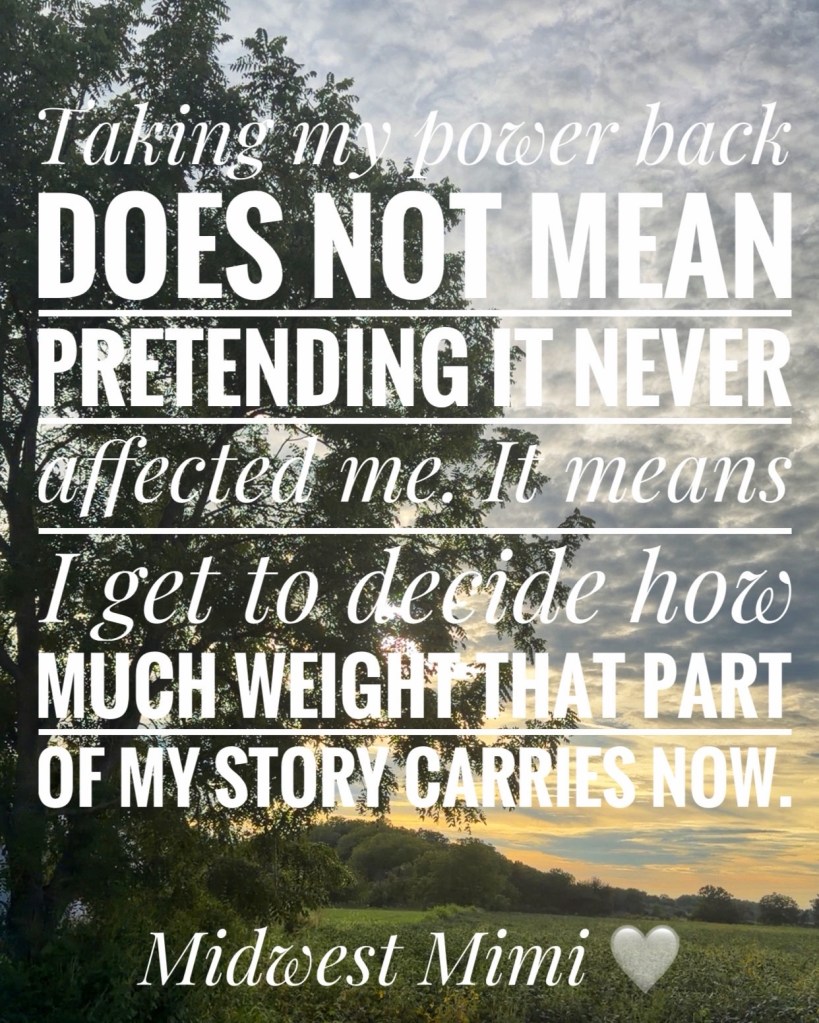
Taking my power back does not mean pretending George never affected me. He did. It means I get to decide how much weight that part of my story carries now.
I can say what happened was awful and never should have happened. I can say it was not my fault. I can say it shaped me without allowing it to define me.
George once had enough power to make a little girl believe she had to keep his secret.
He does not have that power anymore.
I tell the story. I make the meaning.
And the story is mine.

 Midwest Mimi
Leave a comment