“I’m on your porch,” my brother says, because he calls instead of knocking.
“Oh, okay,” I say. “Gimme a minute. I’ll be down.”
We hang up, and I begin the familiar fumble for pants, glasses, and sandals. By the time I get downstairs, he is usually already settled into one of the porch chairs he gave me after he moved into his newly built home. There are two chairs and a small round table between them, hand-me-downs from a life with more space than mine.
I appreciated them. On my porch, they became ours.
The porch rail is that white plastic kind made to stay white and never need painting, and on the other side of it my container garden is trying its best to become something.
My wife, Thy, brings us cold bottles of water. Colin pulls a pack of Lucky Strike Reds from his pocket, and we both smoke one even though we are trying to quit and are terrible at it. Sitting on that porch together feels like it requires smoke.
Maybe it is the way the evening cools off. Maybe it is the way the neighborhood never fully settles. Maybe some conversations need something to do with your hands.
My brother has a beautiful new home with quiet rooms and plenty of space, but he likes my porch in the projects. He likes the action.
People are always outside here. Kids running. Cars blowing the stop sign. Neighbors yelling across parking lots. Somebody laughing too loud. Somebody mad. The “Cookie Lady,” who earned her name exactly the way it sounds, stops by to swipe a smoke and have a full-blown conversation with you in her native language as if you understand every word. There is always something happening.
He could sit in peace at his own house. Instead, he parks his Harley outside my low-income unit and sits beside me like he belongs there.
That is where he said it.
“I realize I am the common denominator in the equation of two divorces,” he said. “Maybe it’s me.”
He said it like a joke.
My brother says a lot of true things like jokes. It gives the truth somewhere to hide if the room gets too quiet.
I did not answer right away. The kids were outside. Thy was nearby, alternating between pulling weeds and chasing Royce. The air had cooled enough to make the porch worth sitting on. His cigarette burned between his fingers. The Harley sat out front, bright blue and expensive, looking out of place and perfectly at home at the same time.
“Well,” I said. “I don’t know.”
But I did know a little.
Not all of it. Not the inside of his marriage. Not the private rooms I was not invited into or the things said when nobody else was around. Being someone’s sister does not make me the judge of their marriage.
But I know my brother, and I knew what sat underneath the joke.
He was wondering if the same thing that made him successful had also made him hard to stay married to. The business. The employees. The partners who depend on him. The inventions in his head that he has to build into existence. The problems only he knows how to solve. The people whose checks clear because he keeps showing up.
Marriage. A home. The version of happily ever after we thought we inherited.
Maybe some people get all of it. He was finally wondering if he was not one of them.
My parents made love look possible when we were kids.
Not perfect. I mean possible. I mean fun. I mean something so steady you never even questioned that it would last.
They had lives together and separate from each other. My dad had his work and his interests. My mom had hers. They gave each other room to be themselves, and then they came back together on purpose.
A few years before my mother’s Alzheimer’s diagnosis, they started taking short weekend trips to learn things together. One of those trips was a French pastry class. They left for the weekend and came home with pastries so flaky and buttery they tasted like proof that the real grown-ups had been keeping secrets from me.
There was also the chocolate. Every Valentine’s Day, my dad bought my mom chocolates from Lagomarcino’s, the local Swedish chocolate shop she loved. We saw it so often that it became part of what love looked like. My brother followed the pattern later and bought those same chocolates for his wife.
I remember my dad pulling my mom into his lap in his recliner when we were young. She would laugh and tell him she was going to squish him, but she settled against him anyway. Just for a few minutes. Just long enough for us to see that they liked each other, not only loved each other in the responsible married-people way.
Then Early Onset Alzheimer’s changed the terms.
My dad kept working for a while, and my mom went to an adult day program a few days a week. When things got worse, he worked from home first. Then he retired so he could care for her full time.
When she was no longer safe at home and had to move into memory care, he did not treat that as the end of his responsibility. He went to have lunch with her and stayed through dinner. He helped her shower so she could keep as much dignity as possible. He made sure she got her meds. Then he watched TV or read in her room until she fell asleep before going home alone.
On days he did not feel well, he called one of us.
“I’m not feeling well today,” he would say. “Can you go have dinner with your mom?”
He did not want her to feel left there.
When the pandemic came and the world started locking doors, my dad told the memory care staff that if they would not let him in to spend each day with his wife, he would take her home right then. He was not going to let a pandemic steal the last months he had with her.
He honored the promise of commitment until her final breath.
That was the love my brother and I were raised under. Not the movie version. The daily version. The pastry-class version. The recliner version. The chocolate version. The lunch-through-dinner-in-memory-care version.
We inherited the example.
We did not inherit the lives that made it possible.
That may be one of the harder things about growing up. You can watch people love each other well. You can learn from them. You can even want exactly what they had. None of that guarantees your love will take the same shape.
So when my brother sat on my porch and joked that maybe he was the common denominator, there was grief under it.
Not soft grief. Not the kind that asks to be held. A sharper kind.
The grief of measuring your life against the best thing you saw and realizing yours did not turn out the same way. The grief of learning that good love can be modeled but not handed down like an inheritance.
My brother’s pattern is not laziness or indifference. That would be easier to judge.
His pattern is drive. Building. Inventing. Fixing. Improving. Growing.
He thrives when he is making something work better than it worked before. I understand that part of him because I have my own version of it. He does it with steel and ovens and systems and businesses. I do it with sentences.
I know the feeling of needing to keep working at a thing until it finally becomes what I can envision.
But Colin’s work is not only his. People depend on it.
I am one of them. My children are some of them. My dad is one of them. The employees whose families need those checks are some of them too.
The part-time work he gives my family is not extra in some abstract way. Those few hundred dollars a month can be the difference between only covering the bills and being able to replace what breaks. The difference between survival and a few small breaths of room.
And then there is my dad.
Our mother was Colin’s whole heart. There is no one else he has ever loved like he loved her. He watched our dad honor his commitment to her through Alzheimer’s, through memory care, through the slow theft of the woman we all knew.
One of the ways Colin tries to thank him for that now is by taking care of him when he can.
Maybe that is something my brother inherited after all: devotion.
My dad’s devotion looked like sitting beside one woman, day after day, while Alzheimer’s took her from him. Colin’s often looks like building something strong enough to hold the people he considers his.
They are different ways of showing up for people. And sometimes the way we show up for one person or one responsibility leaves less of us somewhere else.
It would be easy to say Colin picked the business over his marriage. Maybe that is true. It would be easy to say he picked himself. Maybe some of that is true too.
But that is not all of it.
He picked his people.
And the terrible part is that picking all of us means he goes home alone.
Marriage is made of people too.
That is the part with teeth.
Because love does not only ask what we meant to do. It asks what our choices cost the people closest to us. It asks whether the same loyalty that makes us admirable in one room makes us absent in another.
It is easy to see the cost of someone else’s choices from outside their marriage. Harder when you turn the question around.
I know something about being the common denominator too.
I am on marriage number three.
That is not the sentence little homeschool girls in Southern Baptist circles are raised to imagine for themselves. I did not grow up dreaming of multiple marriages and blended families and complicated histories. I grew up under parents who started dating at thirteen, married shortly after eighteen, raised their children together, and stayed until death was not a metaphor.
Then I lived.
I made choices. Some wise. Some foolish. Some made from survival. Some made from fear. Some made because I was trying to become the version of myself someone else could love.
My marriage to Thy has lasted longer than the others because I no longer fight myself over who I am. She does not ask me to be someone I am not.
That sounds simple until you have spent years performing versions of yourself that made other people more comfortable. Quieter. Softer. Straighter. Less autistic. Less sick. Less complicated. Less blunt.
She lets me be sick when I am sick. She listens when I get excited about something I read or studied and talk her ear off. She knows I can manage appointments, medications, therapies, paperwork, school needs, and everyone’s complicated schedules, but I will still lose my keys and forget where I left my shoes.
That is not a prettier love than my parents had, but it is more honest than anything I had before.
Honesty did not make it easy.
After Royce was born, I missed my wife while she was still in the house.
Depression pulled her somewhere I could not follow. She slept constantly. She rarely held the baby. She was quiet most of the time, and when she did talk, she often sounded angry.
Meanwhile, there was a newborn to care for, older kids to raise, and a house that still had to keep moving.
I loved her. I understood she was depressed. I was angry sometimes anyway.
Understanding why someone is gone does not mean you stop aching from their absence.
I missed my friend who was always up for an adventure. The woman who could take ten dollars of gas money and a little imagination and turn it into a day the kids would remember.
We used to just drive. We played loud music and kept going until we found a state park, a back-road town, or an ice cream shop. Sometimes we ordered Casey’s pizza in another city and had a picnic in the park. We were good at making something out of almost nothing.
Then, for a while, the woman who made nothing feel like something was somewhere behind her own eyes.
Still, I stayed.
That does not make me better at marriage than my brother. It does not mean I loved more correctly. It means I know enough about the inside of a marriage to understand that staying, leaving, failing, trying, loving, and hurting each other rarely fit into clean little moral categories.
I never told Colin all of that on the porch. I did not need to. I only needed to know it before I decided what his joke meant.
Thy is coming back now. Not all at once. People do not usually return to themselves like doors flying open. Sometimes they come back in small, ordinary ways.
We were listening to music the other day, and she started singing and dancing along again. Then she gave me this look she used to give me, a silly little up-and-down look, unmistakably flirty.
And there she was.
For a second, I saw my wife in there. Her.
I had missed her so much.
That look had always given me butterflies. That day, the butterflies did their entire acrobatic act.
Maybe that is what love is sometimes. Not a grand speech. Not a clean principle. Not a promise made once and never tested.
Sometimes love is French pastries brought home from a weekend class. Sometimes it is lunch through dinner in a memory care room. Sometimes it is a phone call that says, “I’m not feeling well today. Can you go have dinner with your mom?” Sometimes it is waiting for your wife to find her way back to herself.
And sometimes it is building a company so other families can eat, even when the building takes more from your own home than you meant to give.
That last one is the hard one. That is the one left sitting on the porch between me and my brother.
He laughed after he said it, because laughing is easier than letting the truth sit there bare.
Maybe he is the common denominator. Maybe we all are, in one way or another. Not because every failure is our fault, but because we bring ourselves everywhere we go. Our gifts. Our damage. Our habits. Our hungers. Our loyalties.
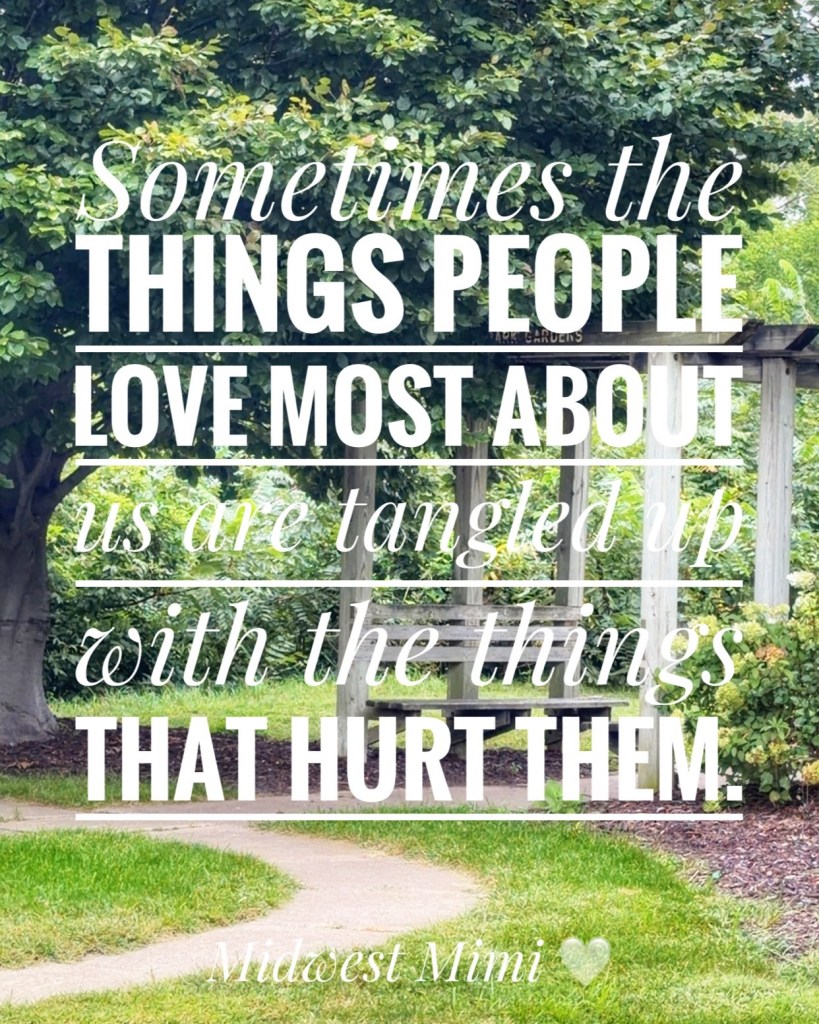
Sometimes the things people love most about us are tangled up with the things that hurt them.
My brother chose his people.
His marriage was supposed to be one of the places his loyalty lived too.
So I did not correct him. I did not comfort him too quickly or turn his joke into a therapy session under the porch light. I let him laugh it off as the joke we both knew it was not.
Then I took another drag from his Lucky Strike.
The blue Harley sat out front beside my van. Thy and the kids were picking up to go inside. The neighborhood kept moving around us, loud and alive.
On the other side of the white porch rail, my container garden kept trying to grow.
 Midwest Mimi
Leave a comment