I do not have the land yet, but I can still teach my family the skills, rhythms, and values of the life I am building toward.
I did not know it was abundance.
I thought it was dinner.
Homemade bread. Canned pears. Homemade grape juice. Fresh tomatoes from the garden. Beef we had raised ourselves. Cloth napkins on the table. A mother who sewed. A big garden. Woods. Pasture. Seventeen acres of space around us.
I did not grow up calling that homesteading.
I called it home.
We had ten acres of pasture and the rest was yard and woods. There was space to move. Space to breathe. Space to be loud or quiet or curious without always being watched by somebody else’s window.
The woods were our playground.
Not in a romantic, polished way. In a real kid way. Sticks, trails, dirt, hiding places, bugs, leaves, scraped knees, and whole afternoons where imagination had room to stretch out.
We did not need someone to design nature for us.
We were allowed to enter it.
The woods did not feel like a destination.
They felt like part of the house.
And there were animals everywhere.
Dogs. Cats. Rabbits. Chickens. Horses. Cows.
Pets and farm animals both. Creatures to feed, watch, love, avoid, chase, respect, and learn from. Animals were not a cute accessory to the life. They were part of the rhythm of it.
There was a garden big enough to feed us in real ways. There was canning and preserving. Bread made every week, sometimes twice a week. My mom sewed and taught me. We used cloth napkins like that was just what people did. We homeschooled. We had food.
Always.
As a kid, I did not understand how much safety lived inside that sentence.
We had food.
I did not know how lucky I was to eat beef we had raised ourselves or fruit my mother had canned from the orchard. I did not know homemade grape juice was not normal everywhere. I did not understand that fresh tomatoes from the garden were different from the ones that sit pale and hard in a store.
I just knew there was food.
I knew the smell of bread.
I knew the rows of jars.
I knew the feel of land around me.
I knew my childhood was different, but I loved it.
Now, as an adult, I understand it differently.
I understand that my parents were not just feeding us. They were teaching us a way of living. A way of making. A way of using what we had. A way of keeping skills alive. A way of making home feel capable.
And I miss that.
I miss the nature.
I miss the space.
I miss the quiet that comes from having land around you instead of people pressed close on every side.
I miss the feeling that the outside belonged to us in some small, ordinary way. Not because we owned every wild thing that moved through it, but because we could step outside and be held by space.
That is the part my body remembers.
The woods.
The pasture.
The garden.
The animals.
The room to breathe.
I do not have that right now.
Right now, I live in town. In low-income housing. In a neighborhood where anything left outside too long might walk away with somebody else. Money is limited. Space is limited. Housing rules limit what I can do. Chronic illness limits how much labor my body can give. Even when I have the desire, I do not always have the capacity.
I do not have a country house.
I do not have land around it.
I do not have a big garden, an orchard, a pasture, a pantry full of home-canned fruit, or the kind of quiet my nervous system keeps reaching for.
But I am trying to remember that this is where we are right now, not proof of where we have to stay.
And I am done believing the life I want can only begin after I can afford the full version of it.
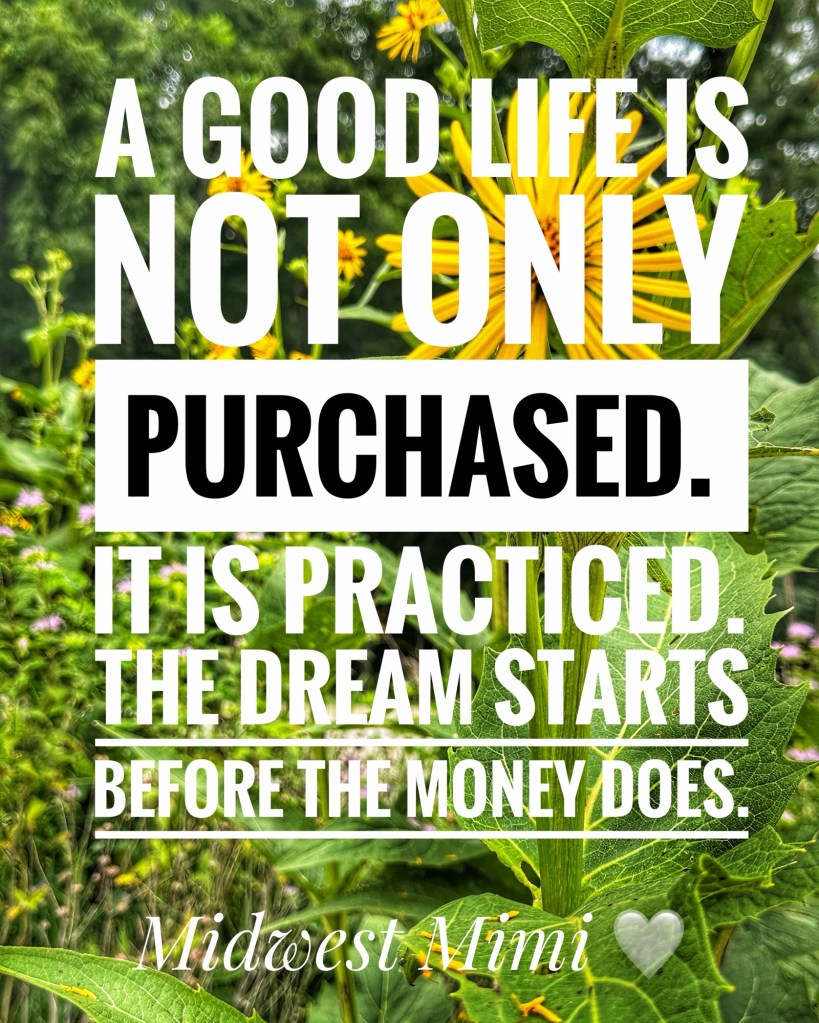
The dream starts before the money does.
That is what I am learning.
I cannot plant an orchard here.
But I can plant sugar snap peas in containers.
I cannot fill a cellar with jars from my own land.
But I can cook more meals at home.
I cannot raise beef.
But I can learn to stretch what we have, make better food from simple ingredients, and teach my kids that feeding people is a skill worth honoring.
I cannot recreate the animal-filled rhythm of my childhood here.
But I can still teach my kids that living things require care. That pets are not decorations. That animals teach responsibility, gentleness, patience, and attention in ways lectures never could.
I cannot have the whole life yet.
But I can practice the values.
That matters.
Because a homestead is not just land.
It is not just chickens and sourdough and linen aprons and pretty baskets in good lighting.
It is not just an aesthetic.
A homestead is a way of asking different questions.
Can I make this instead of buy it?
Can I fix this instead of throw it away?
Can I grow even a little of what we eat?
Can I waste less?
Can I feed my family with more care and less panic?
Can I teach my kids skills they can actually use?
Can I build a home that feels more capable, creative, and rooted, even here?
Even now?
That is the part I can start practicing before I have the land.
I can grow food in containers.
I can cook at home.
I can learn to cook more and more from scratch.
I can start making bread.
I can use rags instead of disposable paper towels.
I can mend what I know how to mend and relearn what I have forgotten.
I can make do.
I can do small DIY projects.
I can homeschool in a way that teaches not just facts, but life.
Right now, my version of homesteading looks less like linen aprons and more like old towels cut into rags, containers lined up where I can keep an eye on them, and me arguing with squirrels like they signed a lease.
It looks like practicing in the middle of the life I actually have.
Not the polished version.
The real one.
I can show my kids that food does not magically appear from a store shelf. Someone grew it. Someone harvested it. Someone cooked it. Someone washed the dishes after. Someone planned enough ahead that dinner could happen.
That knowledge matters.
And I think it matters more now because so many of these skills are disappearing.
Cooking. Sewing. Mending. Preserving. Growing. Repairing. Making do. Feeding people. Working together.
These are not just old-fashioned hobbies.
They are practical forms of resilience.
They are survival skills with warmth in them.
There is dignity in knowing how to make bread.
There is dignity in knowing how to sew on a button.
There is dignity in turning an old towel into rags instead of buying another roll of paper towels every time life gets messy.
There is dignity in putting seeds into dirt and learning what happens next.
There is dignity in teaching your kids that building something together is valuable, even when the thing is small.
Especially when the thing is small.
Because small is where most real things start.
My container garden is not a farm.
I know that.
It is a collection of containers in the life I have right now. A little dirt. A few sprouts. A small fight with squirrels. A reminder that growing food does not wait politely until you have acreage.
It starts where you put the seed.
There is something humbling about that.
Also irritating, because apparently squirrels do not respect dreams.
But even that feels honest.
The life I want will not be all golden-hour garden baskets and perfect homemade bread cooling on the counter. It will be work. It will be failed batches. Bugs. Weather. Body limits. Kids interrupting. Money running short. Something breaking right when I need it to work. A garden that does not care how poetic my intentions were.
I know that.
I do not want to romanticize it into something fake.
The country life I grew up with was beautiful, but it was not effortless. Bread took time. Canning took labor. Gardens had to be weeded. Animals had to be fed. Food security did not come from vibes. It came from work, planning, skill, and repetition.
But that is part of what I miss.
Not the exhaustion.
The capability.
The sense that home was not only a place to consume things.
Home was a place where things were made.
Food.
Clothes.
Lessons.
Stories.
Chores.
Skills.
Family culture.
And childhood was not something that had to be constantly manufactured.
The land helped hold it.
The woods gave us somewhere to imagine.
The animals gave us something to care for.
The garden gave us something to watch.
The house gave us rhythms.
The family gave us belonging.
That is what I want my kids to understand.
I want them to know these skills matter.
I want them to know spending time with family matters.
I want them to know building something together matters.
I want them to see that a good life is not only purchased. It is practiced.
It is made in repeated acts.
Cooking dinner.
Watering plants.
Folding rags.
Reading together.
Fixing what can be fixed.
Learning a recipe.
Trying again when the first loaf is dense enough to threaten someone.
Laughing about it and still making another one.
That is the kind of home culture I want to build.
Not perfect.
Capable.
Not fancy.
Rooted.
Not aesthetic.
Useful.
And yes, I want the land someday.
I want the country house.
I want the space around it.
I want the garden.
I want the woods.
I want animals in the rhythm of the home again.
Not as props.
Not as content.
As responsibility. Companionship. Noise. Mess. Warmth. Life.
Chickens scratching.
Dogs underfoot.
Cats claiming whatever they want.
Rabbits twitching their noses.
Maybe horses or cows again someday, if the land and the season of life allow it.
I want room for my kids and eventually grandkids to run, explore, build forts, get dirty, get bored, name trees, follow bugs, make up worlds, and learn what the outside feels like when it is not just a place between buildings.
I want quiet.
I want safety.
I want food growing where my family lives.
I want something real that belongs to us.
Maybe that is part of why I keep writing Sunny Day Farm too.
Before I can build the real place, I am building the shape of it in story. The orchard. The paths. The animals. The garden. The kind of place where kids learn by touching the world, not only being told about it.
Even the fictional farm is practice.
But I am not waiting for that place to begin becoming the kind of person who knows what to do with it.
That is the mistake I think a lot of us make with dreams.
We think the dream begins when the setting is right.
When the money is there.
When the house is ours.
When the land is bought.
When the body cooperates.
When the kids are older.
When the timing is cleaner.
But the values of a life can begin before the full life is possible.
The rhythms can begin.
The skills can begin.
The mindset can begin.
The family culture can begin.
The dream can start in a container garden.
It can start with a rag basket.
It can start with a pot of soup.
It can start with teaching a kid how to cook eggs, read a recipe, water a plant, sew a seam, or understand that food and family are both worth tending.
Limits change the shape of the practice.
They do not erase the practice.
That line matters to me because my life has limits.
Real ones.
Money limits.
Housing limits.
Energy limits.
Health limits.
Neighborhood limits.
There are things I cannot do here. There are things I cannot leave outside. There are projects that would be foolish in this space. There are days my body will not let me do even the small version.
But there are still pieces I can practice.
And pieces count.
I know they count because I have watched it happen in other areas of my life.
My writing did not become stronger all at once.
My art did not develop a style overnight.
My book draft did not appear whole and finished.
It all came from returning.
Little by little.
Practice by practice.
Page by page.
Line by line.
Seed by seed.
That is how a life gets built too.
Not only through big escapes or dramatic changes, but through small repeated choices that teach your hands, your home, and your family a different way to live.
I did not know it was abundance when I was a child.
I thought it was dinner.
Now I know better.
I know homemade bread was not just bread.
It was skill.
Canned pears were not just pears.
They were planning.
Homemade grape juice was not just juice.
It was memory in a jar.
Fresh tomatoes from the garden were not just tomatoes.
They were land, labor, weather, patience, and care.
The woods were not just woods.
They were freedom.
The animals were not just animals.
They were relationship.
The life I grew up in gave me more than nostalgia.
It gave me a blueprint.
And even if I cannot build the whole thing yet, I can still trace the lines.
I can still teach my kids that these things matter.
I can still practice the skills.
I can still honor the version of home I came from while building toward the version of home I want to give them.
I do not have the country house yet.
I do not have the land around it.
I do not have the orchard, the pasture, the big garden, the animals, or the quiet woods my body misses.
But I have containers.
I have rags.
I have a kitchen.
I have kids who can still learn that food comes from somewhere, that repair matters, that living things require care, that family time is worth protecting, and that a life can be built before it is fully afforded.
I am not trying to cosplay a farm life.
I am trying to remember one.
And I am trying to practice it in small ways until the bigger version has somewhere to land.
 Midwest Mimi
Leave a comment