Part Two: Learning to See the Living as Human
When my mom died, I didn’t just lose her. I also lost the version of my family I had always known.
My dad left. My brother went quiet. And I was left trying to hold relationships that no longer had the same shape.
It felt like I was being abandoned.
It took time and counseling to understand that I was watching the other people in my family experience their grief in ways that looked nothing like mine.
Years earlier, when I was a teenager, one of my dad’s friends died by suicide. I remember my dad saying then that he would never make that choice. He said that if he ever felt that lost, he would disappear to the Ozarks and go fishing by himself every day.
After losing my mom, he did a version of just that.
It turns out, it is more golf than fishing. But the underlying truth is the same. He did what he had always said he would do if pain became too heavy. He withdrew in order to continue living.
I had to learn to see my dad as more than just a dad. I had to allow him to be human in front of me in order to see his pain. Understanding didn’t erase missing my dad, but it changed the story I had been telling myself about him.
After my mom died, my brother and I had communication struggles as well. My mom had always been the bridge. The translator. The one who helped us understand each other when things became tangled.
I remember trying to involve my dad in one of our sibling misunderstandings after my mom died. My dad responded with, “I love you, but I am retired now. I’m not your dad anymore. We’re just friends now.”
It was funny and quietly devastating at the same time. On the surface, it sounded like a joke. Underneath it was the truth.
My dad was not rejecting me. He was telling me that role had belonged to my mom, and without her, my brother and I would have to learn how to communicate with each other ourselves. I had to grieve that loss too.
I also had to face something hard about my relationship with my brother. We did not grieve the same way. He did not want to talk about her. I did. He processed inward. I processed out loud.
Counseling helped me understand that I could not let where he was in his grief determine the shape of my life.
He is my brother, and I love him deeply. I always will.
But his way of surviving could not become the standard for how I was allowed to live.
I learned that we were not always going to think the same. That I could disagree with him, even be told I was wrong, and still love him anyway.
That love did not require alignment.
That relationship did not require sameness.
Grief was teaching me something I had never learned before.
That the people we love are not just roles.
They are human beings carrying pain in different ways.
And if I wanted to keep loving the people who were still here, I had to learn how to see them not only as who I needed them to be, but as who they actually were.
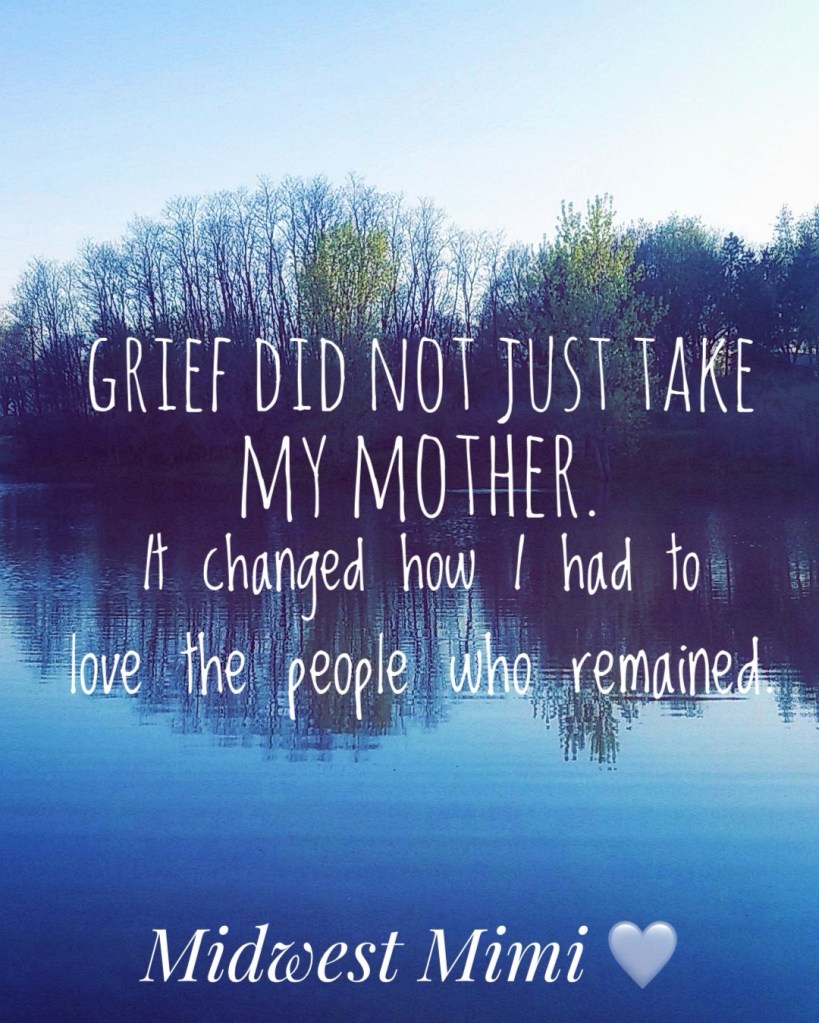
Grief did not just take my mother.
It changed how I had to love the people who remained.
 Midwest Mimi
Leave a comment