I grew up surrounded by books. Both of my parents were avid readers, and the legacy of their love of reading shaped who I am and how I see the world to this day.
My mom, Elaine, was both our homeschool teacher and our church’s librarian. She chose a literature-based curriculum that placed stories at the center of everything we learned.
My dad, Steve, had a read-aloud voice that could make even the longest day feel safe and settled. At night, after we were tucked into bed, he would sit on the top step in the hallway and read us chapters from The Happy Hollisters. We begged for “just one more chapter, Dad,” until it was long past bedtime.
Books in my family weren’t just fun. They built belonging. My parents taught me that stories could be peace and anchors in a world that often felt uncertain.

How Reading Builds Connection and Resilience in Children
Looking back, I see how much those rituals formed the foundation of who I am. Stories weren’t just entertainment. They built resilience. Through books, I was able to try on new perspectives, feel empathy for characters very different from myself, and explore how people solved problems in both history and fiction. That practice of stepping into another’s shoes is what builds emotional intelligence in children.
The Benefits of Reading for Kids, Teens, and Adults
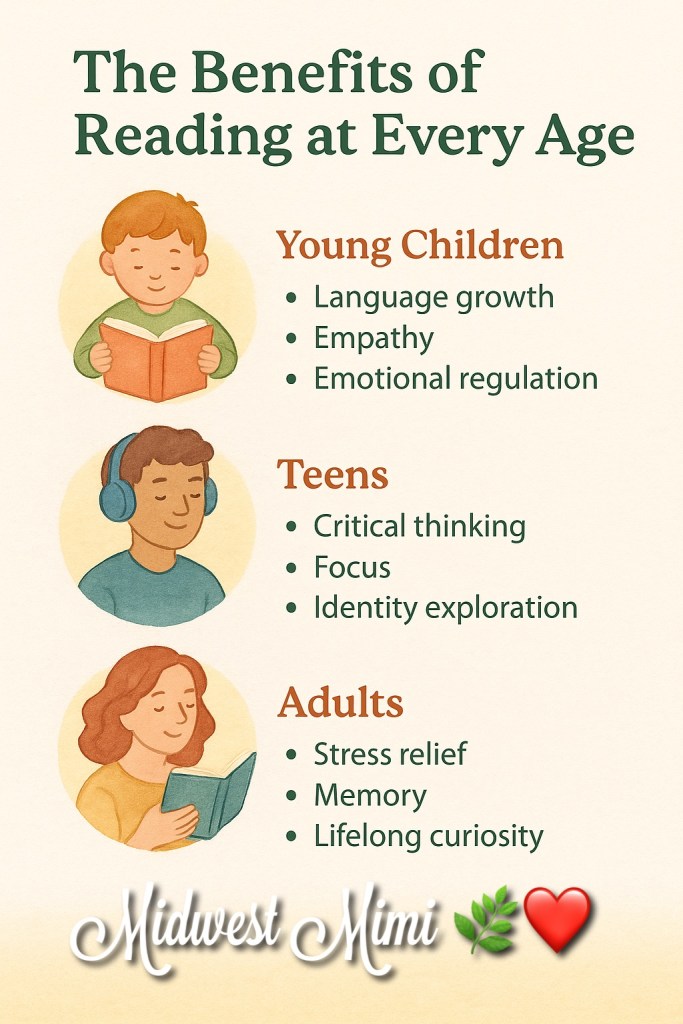
Research confirms what I experienced: children who are read to regularly develop stronger vocabularies, deeper empathy, and greater critical thinking abilities. One study found that reading literature improves inferential and analytical thinking—core skills for critical thinking and problem-solving.
For teens, reading for pleasure has been linked to higher reasoning and cognitive performance later in life. And for adults, even a few minutes of daily reading can lower stress, sharpen memory, and keep our minds curious and flexible.
Reading is one of the rare habits that strengthens us at every age, building skills, empathy, and resilience across generations.
Carrying on a Family Legacy of Reading
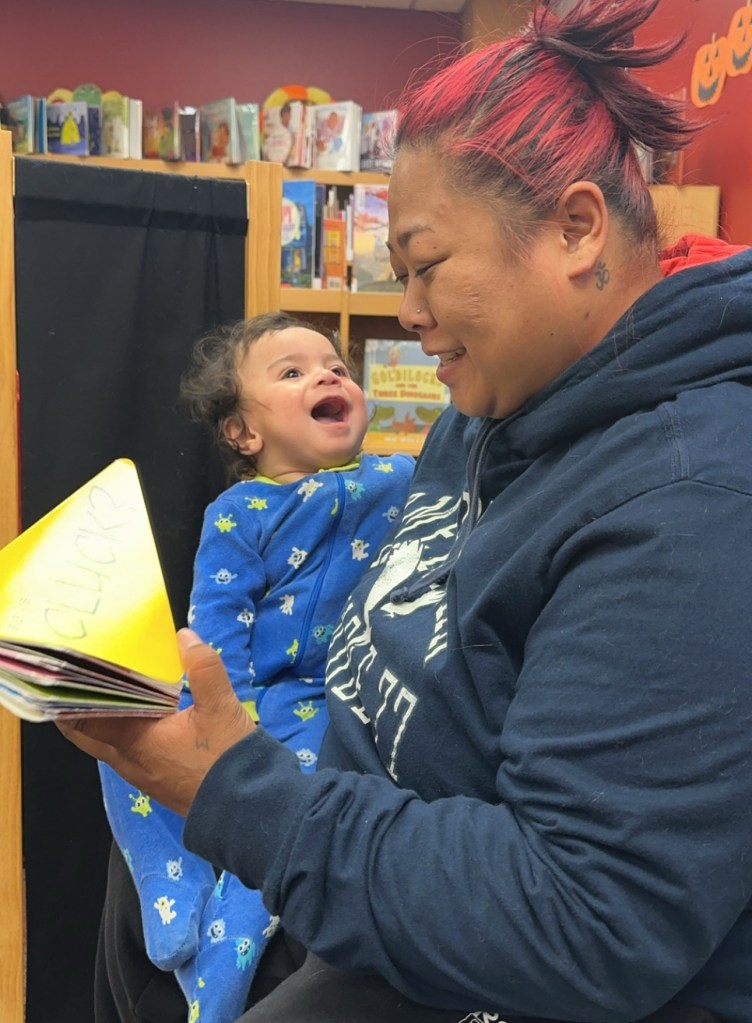
That reading legacy didn’t stop with me. When Raeleigh was little, my mom—her Nana—introduced her to 1000 Books Before Kindergarten. At first, it sounded impossible, but really it came down to consistency. A book every time she wanted to cuddle. A stack from the library. The same favorite read again and again at bedtime. Slowly, those books added up.
More importantly, it built a rhythm of connection. Raeleigh learned early that reading wasn’t a chore. It was a daily part of belonging.
Now in our homeschool, reading still sits at the center. Some days that looks like reading aloud together on the couch. Other days it’s listening to an audiobook while we work on creative projects or chores. With chronic illness and disability shaping our routines, books give us the flexibility to keep learning and connecting, no matter where or how the day unfolds.
Raising Readers: How Each Child Connects With Books
Each of my kids connects with reading in their own way, and each story is part of how resilience and belonging are built in our family.
Raeleigh learned to read early and with almost no instruction. All of the books she had read with her Nana prepared her to be a reader, and she was excited to take on this new skill. As a teen, she still reads often, usually choosing graphic novels for fun. For school, she often prefers audiobooks, letting her listen while she draws or completes chores. Reading has become woven into her daily rhythms, both for learning and for pleasure.
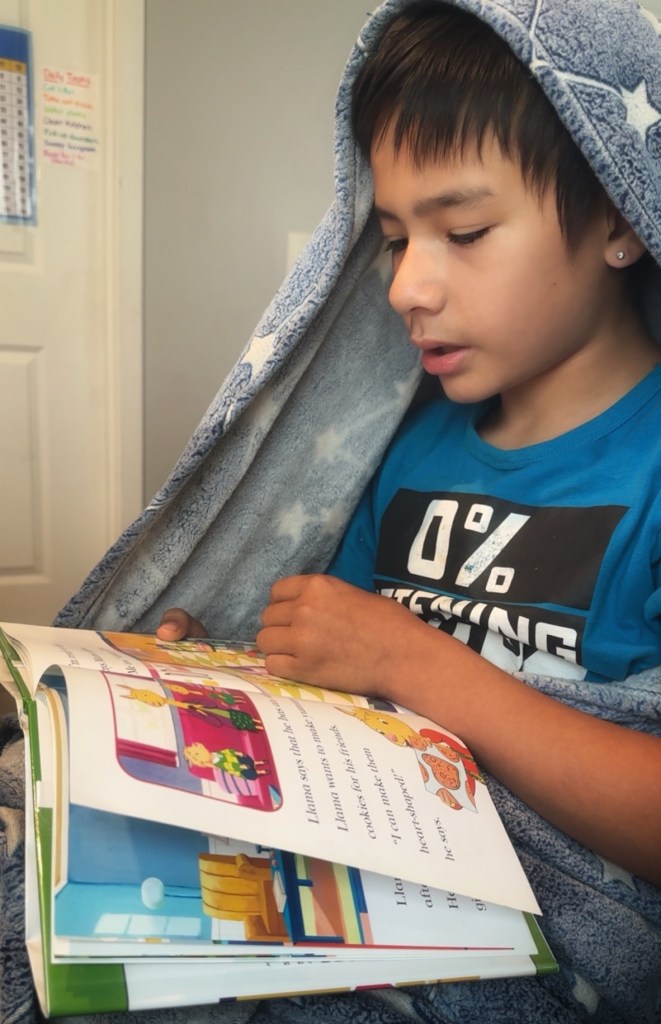
Channing had a different path. He really struggled with reading in public school, but since beginning to homeschool, his reading has improved dramatically. The one-on-one attention helps, and he now practices reading aloud each school day with an adult. Audiobooks are also part of his schoolwork, and they’ve boosted his listening comprehension, expanded his vocabulary, and given him confidence when he reads aloud.
Royce is still a toddler, but already loves the ritual of going to the library and picking out new books with us. Some of the sweetest moments are when Raeleigh reads aloud to him three days a week, and to Channing two days a week. These shared reading times not only nurture Royce’s early love of books, but also create a bond between siblings.
What I love most is that reading looks different for each child, but the thread is the same. Books are building confidence, imagination, and connection no matter their level.
Why Reading Still Matters for Adults
As parents, it’s easy to see reading as something for the kids, but the truth is it’s just as powerful for us. Reading gives adults a way to step out of stress, stretch our thinking, and strengthen our own resilience. It models curiosity for our children, showing them that learning doesn’t end with school.
When my kids see me reading, it sends a message: this matters. Books don’t just build smarter kids, they help us become more grounded, thoughtful adults. They remind us to slow down in a fast world.
Reading and Critical Thinking Skills
Perhaps one of the greatest benefits of reading is its quiet ability to teach critical thinking. Every story invites us to ask: What would I do? Whose perspective am I missing? How else could this end? Those questions build mental flexibility and discernment—skills kids need just as much as adults in a noisy, complicated world.
A Legacy That Continues Through Reading
When I curl up with my children and open a book, I feel the circle continue. I hear my dad’s voice at the top of the stairs, my mom’s insistence that story always mattered most, and I see the same belonging forming in my own kids.
Reading builds connection. It builds resilient kids. And it shapes adults who are still willing to grow. If you’re looking for one small practice that can change your family, start here: open a book. Whether it’s a chapter before bed, an audiobook in the car, or the same picture book for the hundredth time, it matters.
Reading is the thread that ties it all together—past, present, and future.
Mimi 🌿❤️
Further Reading
Reading books improves critical thinking skills – Study showing how literature strengthens analytical and inferential thinking.
Cambridge study: reading for pleasure boosts cognitive performance – Links early reading with higher reasoning and problem-solving later in life.
Why reading is good for mental health – Even six minutes of reading reduces stress by 60%.
Reading strengthens memory in older adults – How reading regularly keeps minds sharp across the lifespan.
 Midwest Mimi
Leave a comment